Which Brain?: A Small Model Decides Who Answers in the Kitchen
Built in-house
Retailbox R&D: built in-house for the AWS Builder Center Agent Experience Hackathon (Strands Decider), 2026
A hands-free kitchen helper for people who can't read a label. A small decision model hears each phrase and decides whether it was meant for the helper, whether it is about medicine, and which Amazon Nova model should answer. On medicine it never guesses: it offers to call a person.
What was the problem?
A phone worn on the chest hears everything in a kitchen. Hands are busy, other people talk, a radio plays, and the thing in the cook's hand might be soup or might be heart medicine. A helper that sends everything it hears to its strongest model is slow and costly, and it answers lines that were never meant for it.
How did Retailbox solve it?
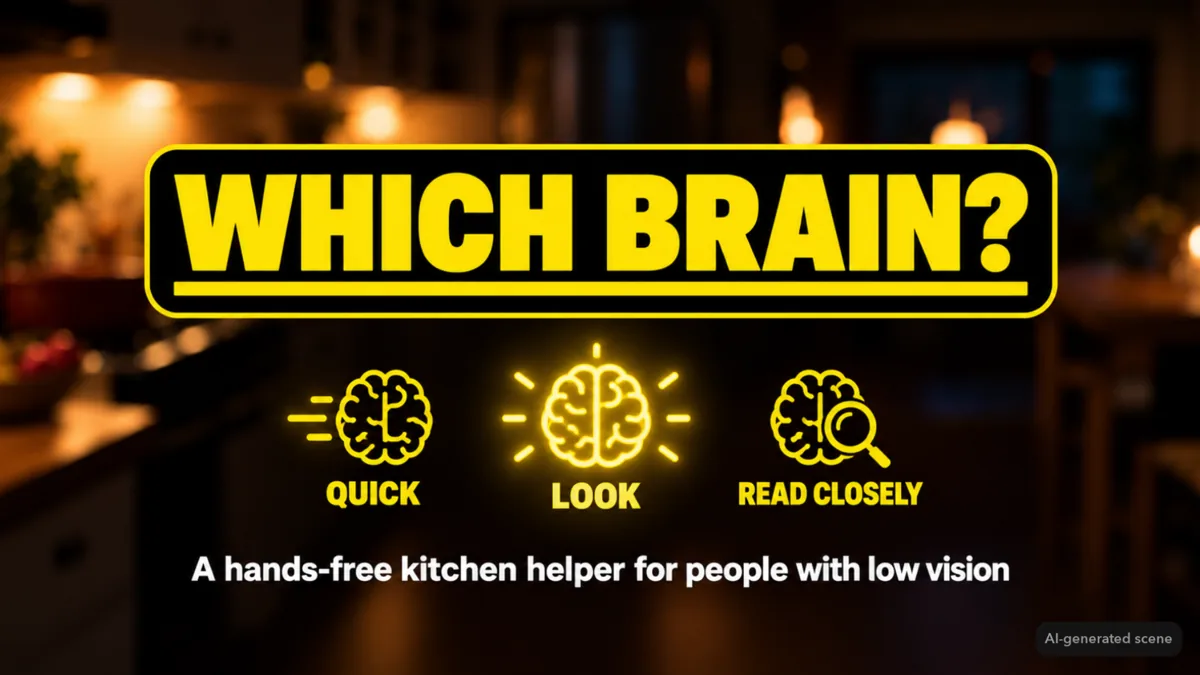
For every phrase, Strands Decider 2B, a small model running as a local server, answers whether the phrase was meant for the helper, whether it is about medicine, and which brain should answer: a quick one (Nova Micro), one that looks at the photo (Nova Lite) or one that reads closely (Nova Pro). Plain code decides what happens next. A voice far from the microphone is ignored without calling any model. A medicine question gets a fixed line spoken by code, with no model running: 'I won't guess on medicine. Want me to call your helper?' When it can't tell whether a phrase was meant for it, it asks 'Did you ask me?' once. The call is dialled only after the person says yes, and the call screen is simulated. A last check in code replaces any answer that mentions a medicine or a dose with the refusal, and the helper never says 'I think' next to a number. Speech goes in through Amazon Transcribe and comes out through Amazon Polly.
We also found that the Strands ClassifierStrategy declines every choice on Amazon Nova (strands-agents 1.61.1), and published a reproduction, a workaround and a drop-in strategy for the Strands model router.
The numbers come from 84 of 120 recorded phrases held out; thresholds were set on the other 36. The phrases are scripted and recorded by one speaker. It was not tested with blind or low-vision users, it is not a pill identifier and it is not medical advice.
Facing the same problem? These are the services that cover this kind of work: AI agent development services.
What does it look like?
 (opens the full-size image in a new tab)
What were the results?
- ✓21 of 21 medicine questions refused on the held-out set, 10 of those 10 with no medicine word in them, and no model answer spoken
- ✓Answered 5 of 22 lines meant for someone else; always sending to Nova Pro answered all 22
- ✓821 ms from the end of speech to the first word at the median, against 1,228 ms for always using Nova Pro
- ✓$0.11 of Bedrock per 1,000 phrases, against $0.83 for always using Nova Pro. The cost of safety: 12 of 41 ordinary questions were also refused, and every one is listed